How to Make an Art Grid Over a Photo on a Mac
- Illustrator User Guide
- Go to know Illustrator
- Introduction to Illustrator
- What's new in Illustrator
- Mutual questions
- Illustrator system requirements
- Illustrator for Apple silicon
- Workspace
- Workspace nuts
- Create documents
- Tools
- Default keyboard shortcuts
- Customize keyboard shortcuts
- Introduction to artboards
- Manage artboards
- Customize the workspace
- Backdrop panel
- Set preferences
- Touch Workspace
- Microsoft Surface Dial support in Illustrator
- Recovery, undo, and automation
- Rotate view
- Rulers, grids, and guides
- Accessibility in Illustrator
- Rubber Mode
- View artwork
- Use the Touch on Bar with Illustrator
- Files and templates
- Synchronize settings using Adobe Artistic Deject
- Tools in Illustrator
- Choice
- Overview
- Choice
- Straight Selection
- Lasso
- Artboard
- Navigation
- Overview
- Zoom
- Rotate View
- Paint
- Overview
- Gradient
- Shape Builder
- Blazon
- Overview
- Blazon
- Type on Path
- Choice
- Introduction to Illustrator
- Illustrator on the iPad
- Introduction to Illustrator on the iPad
- Illustrator on the iPad overview
- Illustrator on the iPad FAQs
- System requirements | Illustrator on the iPad
- What you can or cannot do on Illustrator on the iPad
- Workspace
- Illustrator on the iPad workspace
- Touch shortcuts and gestures
- Keyboard shortcuts for Illustrator on the iPad
- Manage your app settings
- Documents
- Work with documents in Illustrator on the iPad
- Import Photoshop and Fresco documents
- Select and arrange objects
- Create repeat objects
- Blend objects
- Cartoon
- Draw and edit paths
- Draw and edit shapes
- Type
- Work with type and fonts
- Create text designs along a path
- Add your own fonts
- Work with images
- Vectorize raster images
- Colour
- Apply colors and gradients
- Introduction to Illustrator on the iPad
- Cloud documents
- Basics
- Work with Illustrator cloud documents
- Share and collaborate on Illustrator cloud documents
- Upgrade deject storage for Adobe Illustrator
- Illustrator deject documents | Common questions
- Troubleshooting
- Troubleshoot create or salve issues for Illustrator cloud documents
- Troubleshoot Illustrator cloud documents problems
- Basics
- Add together and edit content
- Drawing
- Drawing basics
- Edit paths
- Draw pixel-perfect fine art
- Describe with the Pen, Curvature, or Pencil tool
- Draw simple lines and shapes
- Epitome Trace
- Simplify a path
- Define perspective grids
- Symbolism tools and symbol sets
- Adapt path segments
- Design a blossom in 5 like shooting fish in a barrel steps
- Perspective drawing
- Symbols
- Draw pixel-aligned paths for web workflows
- 3D effects and Adobe Substance materials
- About 3D effects in Illustrator
- Create 3D graphics
- Map artwork over 3D objects
- Create 3D objects
- Create 3D Text
- About 3D effects in Illustrator
- Color
- Virtually color
- Select colors
- Utilise and create swatches
- Adjust colors
- Employ the Adobe Color Themes panel
- Color groups (harmonies)
- Color Themes panel
- Recolor your artwork
- Painting
- Near painting
- Paint with fills and strokes
- Live Paint groups
- Gradients
- Brushes
- Transparency and blending modes
- Apply stroke on an object
- Create and edit patterns
- Meshes
- Patterns
- Select and suit objects
- Select objects
- Layers
- Grouping and expand objects
- Move, align, and distribute objects
- Stack objects
- Lock, hide, and delete objects
- Indistinguishable objects
- Rotate and reflect objects
- Reshape objects
- Crop images
- Transform objects
- Combine objects
- Cut, divide, and trim objects
- Boob Warp
- Calibration, shear, and distort objects
- Blend objects
- Reshape using envelopes
- Reshape objects with effects
- Build new shapes with Shaper and Shape Builder tools
- Work with Live Corners
- Enhanced reshape workflows with touch on back up
- Edit clipping masks
- Live shapes
- Create shapes using the Shape Builder tool
- Global editing
- Type
- Add text and work with type objects
- Manage text area
- Fonts and typography
- Format type
- Import and export text
- Format paragraphs
- Special characters
- Create type on a path
- Character and paragraph styles
- Tabs
- Text and type
- Notice missing fonts (Typekit workflow)
- Update text from Illustrator 10
- Standard arabic and Hebrew type
- Fonts | FAQ and troubleshooting tips
- Create 3D text effect
- Creative typography designs
- Calibration and rotate type
- Line and character spacing
- Hyphenation and line breaks
- Text enhancements
- Spelling and language dictionaries
- Format Asian characters
- Composers for Asian scripts
- Create text designs with blend objects
- Create a text poster using Image Trace
- Create special furnishings
- Work with furnishings
- Graphic styles
- Create a drop shadow
- Appearance attributes
- Create sketches and mosaics
- Driblet shadows, glows, and feathering
- Summary of effects
- Web graphics
- All-time practices for creating web graphics
- Graphs
- SVG
- Create animations
- Slices and image maps
- Drawing
- Import, consign, and salve
- Import
- Import artwork files
- Import bitmap images
- Import artwork from Photoshop
- Place multiple files | Illustrator CC
- Unembed images
- Import Adobe PDF files
- Import EPS, DCS, and AutoCAD files
- Links information
- Creative Cloud Libraries in Illustrator
- Creative Cloud Libraries in Illustrator
- Save
- Save artwork
- Export
- Apply Illustrator artwork in Photoshop
- Export artwork
- Collect assets and export in batches
- Parcel files
- Create Adobe PDF files
- Extract CSS | Illustrator CC
- Adobe PDF options
- File information and metadata
- Import
- Printing
- Prepare for printing
- Fix documents for printing
- Change the folio size and orientation
- Specify crop marks for trimming or aligning
- Get started with large canvas
- Press
- Overprint
- Print with color direction
- PostScript press
- Impress presets
- Printer's marks and bleeds
- Print and save transparent artwork
- Trapping
- Print color separations
- Print gradients, meshes, and colour blends
- White Overprint
- Prepare for printing
- Automate tasks
- Data merge using the Variables panel
- Automation with scripts
- Automation with actions
- Troubleshooting
- Crash issues
- Recover files after crash
- File issues
- GPU device driver issues
- Wacom device issues
- DLL file problems
- Memory issues
- Preferences file issues
- Font issues
- Printer issues
- Share crash report with Adobe
Use rulers
Rulers help you accurately identify and measure out objects in the illustration window or in an artboard. The bespeak where 0 appears on each ruler is called the ruler origin.
Illustrator provides separate rulers for documents and artboards. You can select just 1 of these rulers at a fourth dimension.
Global rulers appear at the acme and left sides of the illustration window. The default ruler origin is located at the top-left corner of the analogy window.
Artboard rulers announced at the top and left sides of the active artboard. The default artboard ruler origin is located at the top-left corner of the artboard.
The deviation between artboard rulers and global rulers is that if you select artboard rulers, the origin point changes based on the active artboard. In improver, you can take different origin points for artboard rulers. At present, if y'all change the artboard ruler origin, the pattern fills in objects on the artboards are non afflicted.
The default origin point for the global ruler is at the upper-left corner of the first artboard and the default origin for the artboard rulers is at the top left corner of the corresponding artboard.
- To show or hide rulers, choose View > Rulers > Show Rulers or View> Rulers > Hibernate Rulers.

-
To toggle between artboard rulers and global rulers, cull View > Rulers > Alter to Global Rulers or View > Rulers > Change to Artboard Rulers. Artboard rulers appear past default, and so the Change to Global Rulers option appears in the Rulers sub-menu.
-
To testify or hide video rulers, choose View > Testify Video Rulers or View > Hide Video Rulers.
-
To change the ruler origin, move the pointer to the upper-left corner where the rulers intersect, and drag the pointer to where you lot desire the new ruler origin.
Equally you drag, a cantankerous hair in the window and in the rulers indicates the irresolute global ruler origin.
Notation: Changing the global ruler origin affects the tiling of patterns.
-
To restore the default ruler origin, double-click the upper-left corner where the rulers intersect.
The coordinate system has now been switched to fourth quadrant, which was previously the commencement quadrant. In Illustrator CS5, when y'all move downwards, the value of y-axis increases and if you lot move toward right, the value of x-centrality increases.
For saving to legacy versions of Illustrator, the Global rulers remain at the position set in legacy document. Although, the origin point does not move to upper left, the coordinate system changes to fourth quadrant.
The change in coordinate organisation and the ruler origin does not employ to scripting, which allows you to retain old scripts. Withal, when you transform objects using scripting, the Y coordinate values differ from the values that y'all set in the Illustrator user interface. For instance, if you utilize a move performance of say Y= +10 points, then to emulate the same movement with scripting, employ a transformation of Y = -10pts.
Change the unit
The default unit in Illustrator is points (a point equals .3528 millimeter). You tin alter the unit that Illustrator uses for general measurements, strokes, and type. You can override the default unit of measurement while entering values in boxes.
- To change the default unit, choose Edit > Preferences > Units (Windows) or Illustrator > Preferences > Units (Mac Bone), and then select units for the General, Stroke, and Type options. If Show Asian Options is selected in the Type preferences, you can likewise select a unit specifically for Asian type.
Note: The Full general measurement choice affects rulers, measuring the distance between points, moving and transforming objects, setting filigree and guides spacing, and creating shapes.
- To set the general unit of measurement for the current document merely, choose File > Document Setup, choose the unit you want to employ from the Units bill of fare, and click OK.
- To change the unit of measurement when entering a value in a box, follow the value by whatsoever of the following abbreviations: inch, inches, in, millimeters, millimetres, mm, Qs (i Q equals 0.25 millimeter), centimeters, centimetres, cm, points, p, pt, picas, pc, pixel, pixels, and px.
Tip: When mixing picas and points, yous can enter values as XpY, where Ten and Y are the number of picas and points (for example, 12p6 for 12 picas, half dozen points).
Apply the grid
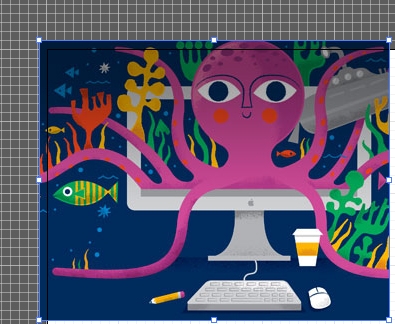
The grid appears behind your artwork in the analogy window. It does non impress.
- To show or hide the filigree, choose View > Bear witness Grid or View > Hide Grid.
- To snap objects to gridlines, cull View > Snap To Grid, select the object you want to move, and drag it to the desired location.
When the object's boundaries come within 2 pixels of a gridline, it snaps to the point.
Notation: If you choose View > Pixel Preview, Snap To Filigree changes to Snap To Pixel.
- To specify the spacing between gridlines, grid mode (lines or dots), grid colour, or whether grids announced in the front or back of artwork, choose Edit > Preferences > Guides & Filigree (Windows) or Illustrator > Preferences > Guides & Grid (Mac OS).
Use guides
Guides aid you marshal text and graphic objects. You can create ruler guides (straight vertical or horizontal lines) and guide objects (vector objects that you convert to guides). Like the filigree, guides exercise non print.
You tin can choose betwixt 2 guide styles—dots and lines—and you can change the color of guides by using either predefined guide colors or colors you select using a color picker. Past default, guides are unlocked then that you tin can move, modify, delete, or revert them, but you can choose to lock them into place.
- To show or hide guides, choose View > Guides > Show Guides or View > Guides > Hide Guides.
- To modify guide settings, cull Edit > Preferences > Guides & Filigree (Windows) or Illustrator > Preferences > Guides & Grid (Mac Os).
- To lock guides, select View > Guides > Lock Guides.
Create guides
-
If the rulers aren't showing, choose View > Show Rulers.
-
Position the pointer on the left ruler for a vertical guide or on the pinnacle ruler for a horizontal guide.
-
Drag the guide into position.
To catechumen vector objects to guides, select them and choose View > Guides > Make Guides.
To make working with multiple guides easier, movement them into a separate layer.
-
To restrict the guides to an artboard instead of the unabridged canvas, select the Artboard tool and elevate the guides on to the artboard.
Motion, delete, or release guides
-
If guides are locked, select View > Guides > Lock Guides.
-
-
To move the guide, drag it or copy it.
-
To delete the guide, press the backspace fundamental (Windows) or the Delete primal (Mac OS), or choose Edit > Cut or Edit > Clear.
-
To delete all guides at in one case, cull View > Guides > Clear Guides.
-
To release the guide, turning it back into a regular graphic object, select the guide and choose View > Guides > Release Guides.
-
Snap objects to anchor points and guides
-
Choose View > Snap To Point.
-
Select the object you want to movement, and position the pointer on the exact signal you desire to align with anchor points and guides.
When snapping to a point, the snapping alignment depends on the position of the pointer, not the edges of the dragged object.
-
Drag the object to the desired location.
When the pointer comes within 2 pixels of an anchor signal or guide, information technology snaps to the point. When a snap occurs, the pointer changes from a filled arrowhead to a hollow arrowhead.
Use Smart Guides
Smart Guides are temporary snap‑to guides that appear when yous create or dispense objects or artboards. They help y'all align, edit, and transform objects or artboards relative to other objects, artboards, or both by snap-aligning and displaying X, Y location, and delta values. Yous can specify the type of smart guides and feedback that appear (such as measurement labels, object highlighting, or labels) by setting the Smart Guides preferences.
Smart Guides are on past default.
-
To plough Smart Guides on or off, choose View > Smart Guides.
-
Use Smart Guides in the following means:
-
When you lot create an object with the pen or shape tools, use the Smart Guides to position a new object'due south anchor points relative to an existing object. Or, when you create a new artboard, use Smart Guides to position it relative to another artboard or an object.
-
When you create an object with the pen or shape tools, or when you transform an object, employ the Smart Guides' construction guides to position anchor points to specific preset angles, such as 45 or ninety degrees. Specify these angles in the Smart Guides preferences.
-
When you move an object or artboard, apply the Smart Guides to align the selected object or artboard to other objects or artboards. The alignment is based on the geometry of objects and artboards. Guides announced as the object approaches the edge or center betoken of other objects.
-
When you transform an object, Smart Guides automatically announced to assist the transformation.
You tin change when and how Smart Guides appear by setting Smart Guides preferences.
When Snap To Grid or Pixel Preview is turned on, you lot can't use Smart Guides (even if the menu control is selected).
-
Set Smart Guides preferences
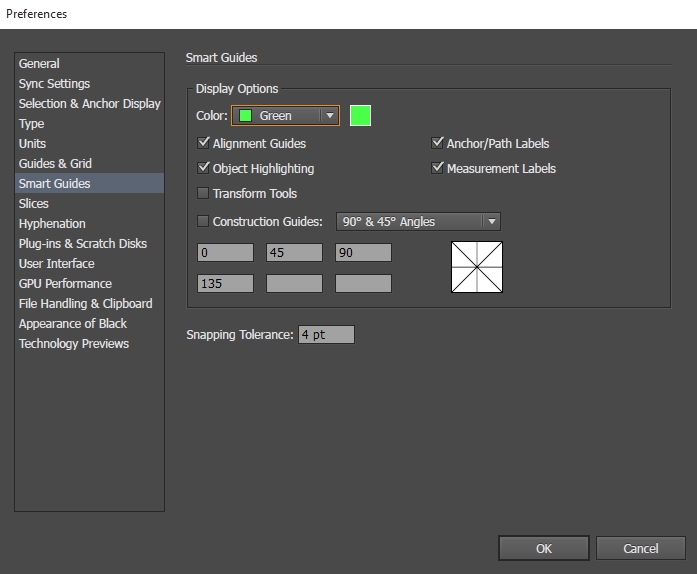
Cull Edit > Preferences > Smart Guides (Windows) or Illustrator > Preferences > Smart Guides (Mac Bone) to set the post-obit preferences:
Color
Specifies the color of the guides.
Alignment Guides
Displays guide lines that are generated along the center and edges of geometric objects, artboard, and bleeds. They are generated when yous move objects and when yous perform operations such as drawing basic shapes, using the Pen tool, and transforming objects.
Anchor/Path Labels
Displays information when paths intersect and when they are centered on an anchor point.
Measurement Labels
Displays information for many tools (such as Cartoon tools and Text tools) most the position of the cursor as you lot position the cursor over an anchor point. While you create, select, move, or transform objects, information technology displays the x and y delta from the object's original location. When you printing Shift with a cartoon tool selected, the starting location appears.
Object Highlighting
Highlights the object below the pointer every bit you elevate around it. The highlight colour matches the object'southward layer colour.
Transform Tools
Displays information when y'all scale, rotate, and shear objects.
Construction Guides
Displays guidelines as you depict new objects. You lot specify the angles at which you want guidelines drawn from the anchor points of a nearby object. You lot can fix to half-dozen angles. Enter an angle in the selected Angles box, select a prepare of angles from the Angles pop‑upward carte, or select a gear up of angles from the pop‑up carte du jour and change 1 of the values in the box to customize a prepare of angles. The preview reflects your settings.
Snapping Tolerance
Specifies the number of points the pointer must be from another object for Smart Guides to take effect.
Measure distance betwixt objects
Use the Measure out tool to summate the altitude between any ii points and brandish the results in the Info console.
-
Select the Mensurate tool
 . (Select and agree the Eyedropper tool to see information technology in the Tools panel.)
 -
-
Click the two points to measure out the distance between them.
-
Click the commencement indicate and drag to the 2d signal. Shift‑drag to constrain the tool to multiples of 45°.
The Info panel displays the horizontal and vertical distances from the x and y axes, the absolute horizontal and vertical distances, the full distances, and the angle measured.
-
Navigate the Info panel
Use the Info panel (Window > Info) to get information on the surface area beneath the pointer and on selected objects.
-
When an object is selected and a choice tool is active, the Info console displays the object's 10 and y coordinates, width (West), and elevation (H). The values for width and elevation are affected by the Employ Preview Premises option in the General preferences. When Employ Preview Premises is selected, Illustrator includes the stroke width (and other attributes such equally drib shadows) in the object's dimensions. When Apply Preview Bounds is cleared, Illustrator measures only the dimensions defined past the object's vector path.
-
When you use the Pen tool or Gradient tool, or when y'all motion a selection, the Info console displays the change in ten (W), the modify in y (H), the distance (D), and the angle
 as you drag.
 -
When you utilize the Zoom tool, the Info panel displays the magnification factor and the x and y coordinates after you release the mouse button.
-
When you utilize the Scale tool, the Info panel displays the percentage modify in width (W) and elevation (H) and the new width (Westward) and height (H) after the scaling is consummate. When you utilize the rotate or reflect tools, the Info panel displays the coordinates of the object'due south center and the angle of rotation
 or reflection.
 -
When you lot employ the Shear tool, the Info panel displays the coordinates of the object's center, the bending of shear centrality
, and the amount of shear .
. -
When y'all use the Paintbrush tool, the Info panel displays the x and y coordinates and the name of the current brush.
-
Select Show Options from the panel menu or click the double arrow on the panel tab to display values for the fill and stroke colors of the selected object and the name of whatever pattern, gradient, or tint practical to the selected object.
Note: If yous select multiple objects, the Info console displays only the information that is the same for all selected objects.
More than similar this
Source: https://helpx.adobe.com/illustrator/using/rulers-grids-guides-crop-marks.html
0 Response to "How to Make an Art Grid Over a Photo on a Mac"
Post a Comment