Make America Great Again Spanish Cap
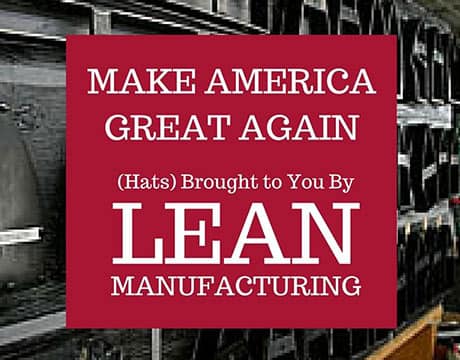
Make America Not bad Again Hat Brought To Yous By Lean Manufacturing
This podcast can be heard on Lean Blog
TRANSCRIPT: Marking Graban: How-do-you-do, this is Mark Graban. Welcome to Episode 234 of the podcast on Nov 16, 2015. Today's guest is Mitch Cahn; he is president of Unionwear, a manufacturer of hats, bags and dress in Newark, New Jersey. I first learned about Mitch and his company at the Northeast LEAN Conference recently, and I blogged nearly that. You lot can find a link to it at leanblog.org/234. At present, what defenseless my eye was the political hats they produce, including the famous carmine "Make America Corking Once more" hat that Donald Trump wears, amid hats produced for other candidates. Beyond the surface of those hats is a fascinating story about competing instead of making excuses. As Mitch explains here in the podcast, Unionwear has been very successful, even though it's producing in one of the highest-cost parts of the world. Unionwear has had to compete against imports from People's republic of china and lower-wage southern states here in the U.s.a., and LEAN has been a major part of their strategy for improving productivity, reducing cost and being fast to market. Now, whether you work in healthcare or manufacturing, you lot'll really love the story, the principles and the ideas behind Mitch, his visitor and his employees.
And so, can you start off by introducing yourself and your visitor, Unionwear?
Mitch Cahn: Certain. My name is Mitch Cahn; I am the President of Unionwear. I started the business in 1992, and we're based in Newark, New Jersey. We manufacture baseball caps and all sorts of headwear, and sewn bags, like backpacks, laptop bags, tote bags, garment bags, and messenger numberless. Everything is 100% fabricated in The states, and everything is made with wedlock labor.
Mark Graban: What prompted you to starting time the business?
Mitch Cahn: I started the concern in 1992. I bought a broke baseball cap manufactory. Before that, I was working in investment cyberbanking, and I really didn't like it. I wanted to exist the customer—I wanted to make stuff. So I spent about a year trying to come up up with an idea to start a business, then I came beyond this small baseball hat mill that had been foreclosed on in Bailiwick of jersey City, New Jersey, and I came up with plenty money to buy the equipment at an auctions auction. I was going to do something different with that business—I was going to start selling baseball caps to the fashion industry, which was not a thing in 1992. You couldn't become into The Gap or Macy's and buy baseball caps back then, and I was actually successful very quickly. The idea caught on, and we picked upwardly customers similar Ralph Lauren, Nordstrom's, and Izod, and we were helped by the growth of outlet stores at that time. Nevertheless, by 1994, our entire business model complanate because all of those clients started manufacturing in China. It happened really quickly; I didn't come across information technology coming. It was only a couple of years later Tiananmen Square; Red china became this giant in the market economy, and ane of the outset items they went later on was baseball game hats, because it'due south nearly all labor.
And so we needed to come up with a new business organisation model quickly, and around that time we came upward with the thought of selling products specifically considering they were made in the United states—going later on the Made in USA market. Nosotros started with labor unions. We actually named the company Unionwear because unions were at that time 1 of our natural markets. We were the only union shop that fabricated baseball hats. They were natural market for us, and and then, by the twelvemonth 2000, we expanded into political campaigns when the Net fabricated it possible for Al Gore's campaign to enhance coin by giving a baseball hat away to every donor. We had that contract, and that's been a big part of our concern ever since.
We slowly looked into other markets that nosotros found were buying American. Later on our LEAN transformation in 2007, nosotros were competitive with not-spousal relationship shops in the deep s. We could even compete with shops in Puerto Rico for military business—now that'southward huge function of our business as well. In 2007, we bought a handbag factory, and we did a LEAN transformation of that factory. At present that'due south near half of our business organisation. Nosotros've continued to aggrandize our markets as the prices of imports continue to surge year subsequently year, while our domestic pricing really remains flat. Nosotros've been able to interruption into more markets, specially B2B markets that are looking at co-brands with the Made in Us characterization, which is actually the about valuable brand in the world.
When someone gives a baseball game hat or handbag abroad, they don't want that product to say "Made in Communist china". A lot of socially responsible companies requite bags and hats away—Whole Foods, Google, and a lot of other companies—and they purchase our products because the union label shows that the products were definitely non fabricated in a sweatshop, and the Made in USA label shows that the products were not shipped halfway effectually the globe. We've also been able to return to the fashion business over the concluding v years for the start time since the early on 90s; we've been more competitive, and fashion businesses take been going for smaller batch manufacturing.
Mark Graban: Information technology sounds like there's a sense of purpose here, whereas a lot of industries and companies go with the flow. When business concern started going to China, all the lemmings said, "Hello, we have to go to Mainland china!" Even before y'all discovered LEAN, why was it important to you to stay in New Jersey?
Mitch Cahn: Well, I always reminded myself (and that'due south the first x years I was in concern) that if I wanted to brand money, information technology would have been a lot easier for me to stay on Wall Street. I didn't want to brand money; I wanted to make products. I discover the manufacturing process extremely rewarding—I come into piece of work, and someone meets me with an idea and leaves a sample. Then I accept to figure out how to industry that sample, what machines to buy and what people to staff. To effigy all that out and and so go out in New York City and see people wearing and using the products is very rewarding. So, that was one part of it—I savour the maker experience. Second, from the starting time I wanted to brand sure that all of our employees were well compensated and had the same benefits as white-neckband workers. Our union was the Ladies Cloth Workers Spousal relationship, and they said we were the first company (and nosotros're still probably the just visitor) that went to them earlier we started the business. We wanted to start a wedlock shop because I knew we were going to requite our employees the benefits that union workers would earn anyway. We might as well take advantage of the relationship that the unions had and use that for marketing purposes.
Mark Graban: I'g curious to hear more most LEAN. How did you first get introduced to the thought of LEAN?
Mitch Cahn: Around 2004, nosotros faced with a lot of increasing expenses that were not really affecting the rest of the country. New Bailiwick of jersey was raising its minimum wage significantly ahead of the federal minimum wage. We were going to run into our wages go upwardly by about 30-40% pretty speedily. We also had big increases in health care at that time, and most of our contest was non-union shops in the S, and in correct-to-work states. In most non-matrimony shops, until ObamaCare, there was no wellness insurance offered, and we started to see the cost ascent over a four-year menses. Nosotros used to pay $50 a worker for wellness insurance, and past 2004, it was about $180. Then our real estate prices right outside the New York expanse started going upward pretty quickly. So we couldn't compete with the South, fifty-fifty for the Made in the U.s.a. work, and I was very concerned with our ability to remain a viable company. I started looking for a magic bullet, and I stumbled upon a LEAN 101 seminar that was being run by a New Jersey Manufacturers' Extension Programme (MEP). I took it, and it actually blew my mind. For anyone who isn't familiar with this plan, it's a national programme, a ane-solar day course that trains everyone from executives to factory workers on the whole LEAN process.
It puts people in a simulated factory making clocks. At the first of the solar day, everyone is using their own traditional methods to set upwards a production line and manufacture very simple clocks with the other executives—these are people who believe they know everything most manufacturing. At the beginning of the day, all these executives working together, with all their brainpower, might produce near fifteen clocks an hour. Throughout the course of the day, LEAN principles are introduced one by 1. Then they practise some other simulated flow, where the manufacturers take the principle they only learned and apply information technology to this mini-production line, and their volume increases. From the kickoff to the end of the day, this grouping of executives will increase their production from 15 clocks to 300-400 clocks an hour! It really opened up my listen to the possibilities in my factory. I still retrieve when I came back, and all I could see was the opposite of LEAN. I was so angry! I was angry at everyone who worked for me for non seeing that they were doing non-value-added work all day, completely forgetting that I had just gone x years without seeing whatsoever of that myself.
Mark Graban: Yeah, it becomes difficult when you suddenly see waste and problems that yous would have looked past earlier.
Mitch Cahn: I only wanted to do everything at once, and of course y'all tin't exercise that, but I did get back to MEP. I hired them for a pocket-sized project while they submitted a grant proposal to the New Jersey Section of Labor to do a LEAN transformation for us. I brought in the consultant from NJ MEP, and he met with our plant director at the fourth dimension and me. The establish manager was very sometime-school, a traditional manufacturing product line person with about 30 years' experience, and he was very skeptical of the consultant. All he wanted to know was how he was going to make our machine operators sew together faster, and the consultant said, "I tin can't practice that. I don't know anything about sewing, to be totally honest with y'all." The plant managing director asked, "How are you perhaps going to meliorate our product here?" and the consultant said "Well, I'm only going to focus on what they're doing when they're not sewing. I worked in food companies, pigment companies and auto companies, and it's always the same things. All I do is look for those things, and I railroad train your workers and your management to eliminate those things through designing the factory differently and training people differently." The plant manager was not convinced, but I brought the consultant in anyway, and nosotros started with a really elementary projection. He went for the depression-hanging fruit, and he took a look at our embroidery operation. Nosotros run about 12 embroidery machines here in the middle of our production process where we embroider our own hats and bags.
He spent a day observing that procedure and asked me, "How long practise you think your machines are down between orders?" I remembered this from the spreadsheet that I looked at when I bought the machines, and I said almost 20 minutes. He'd made a videotape, and he said, "Well, how about an average of nigh 2 i/2 hours?" I didn't believe him. I watched the videotape, though, and I saw that the machines were indeed down as he'd said. In the past, I'd walked effectually and saw anybody working hard and running around, and then I couldn't empathise why the machines were downwards for so long, and this was something that was going on 15 to 20 times a 24-hour interval—that was the average number of orders that we are pushing through the embroidery department a day. It turned out to a very simple problem with a very simple solution.
Our embroidery manager was a Chinese National who spoke English, and our embroidery operators were more often than not from Spanish-speaking countries; they spoke a little English. The director gave the didactics to become pick out threads of certain colors for an society. From the time she gave the instruction to the time they brought back the proper cones was about two and a half hours. Why? Based upon the instructions from the client, she told the staff to look for, say, dark grayness and dark light-green. The employees would exit to the shelves of closed white boxes with the thread colour names on them, and the names were things like cement, and soup and canary then on. They had to open box later box to find the right color thread. If they were lucky, it was the thread the embroidery manager had envisioned in her mind. If they weren't lucky, they had to get dorsum and return with another armful of threads. Then they would accept to count out the threads—threads were shipped to usa in boxes of 12, and our machines had xx heads on them. So they'd count them out, they'd have to observe the commencement of each cone and they'd accept to bring them to the auto, put them on the machine and thread them, and then go dorsum to go the next colour. So the consultant's showtime project was to get rid of all the color names and get rid of the boxes. Nosotros put everything in giant zip-lock bags. We color-coded our factory thread department like a rainbow, and we referred to everything by colour number. We took all the threads and inventoried them in units of 20 to stand for to the machines' 20 heads. Bags would come out to the table; the embroidery machines would exist loaded. When it was over, cones would get back into the bags and be put back on the shelf. The whole procedure went from about 2 and half hours to 15 to 20 minutes pretty quickly, and we were easily able to see the power of LEAN in that department. Nosotros were sold.
And so we went ahead, we got the grant, and nosotros spent near two years putting in every facet of LEAN into the factory. Nosotros put in 5S, we put in all sorts of Kanban, we did single jail cell flow, and every one of these steps was really a phenomenal success for united states of america. The 5S is something that nosotros practice every year, and information technology's something the owner really needs to be involved in. For instance, no one who works for me is going to throw a machine away. I'll say, "Hey, we're never going to use that car! No one is going to pay for it, I simply looked on eBay; we're simply going to sell it for fleck." No 1 else volition say that. So I need to actively bear witness up, ready to go dingy for a couple of days.
Mark Graban: You mentioned the MEP programs, and for people who aren't familiar with that, it'due south a federally sponsored and funded plan, but the MEPs operate at the state level. Some of the MEPs are doing work with healthcare organizations—the Ohio MEP, which works under the proper name TechSolve, is working with both manufacturers and healthcare providers. You talked nigh your healthcare costs going up. If you went into a hospital, I know you lot would meet the parallels of why it takes so long between cases in the operating room. You talked about sewing—nosotros're not request the surgeons to work faster, we're merely trying to maximize the amount of time during the day they can actually be surgeons, and that makes a huge difference in healthcare. Hopefully it'south going to help get costs under control. There are big parallels there.
Mitch Cahn: Yeah, in that location are a lot of parallels betwixt healthcare and manufacturing, and coincidentally, while we were going through the first LEAN transformation my first son was born. The consultant, Dave Hollander, who shepherded u.s. through this whole process, always tells how I came back from the infirmary with all these ideas—it was Mt. Sinai in New York, which was already implementing LEAN—that I wanted to put in our factory. We still apply a lot of those processes, like color-coded folders. At that place are and so many LEAN improvements that we made, but one of the first principles that they taught us was to go rid of tables. Tables are evil! Unless you are using the table for a item job, it'due south going to be filled with garbage, on top and underneath, because that'south human nature. I noticed that in hospitals, if everyone needs a table, they get a rolling cart, so we gave everybody their own rolling cart. We designated places on the cart for everything that they need, and we gave them a small personal space on the lesser for their own stuff. We nevertheless employ that, and apart from the productivity gain, the corporeality of space we gained was great.
Mark Graban: There is a good general LEAN principle: put everything on wheels! Exist flexible so you tin rearrange cells, rearrange the layout, brand changes as customer demand changes to create different capacity—that'due south definitely a smashing lesson. There was a alphabetic character that you lot had posted at the Northeast LEAN Conference. Could you talk a little scrap more than about the thought? I call back a lot of manufacturers still don't get the idea that they can't create value by cut labor costs. Yous have to redeploy labor in creating more value. Can you lot talk about what that's meant for you and the company?
Mitch Cahn: Okay, we take a single-minded focus on creating value. Once the people who piece of work here sympathise what that means, then it becomes a mindset, and it becomes very like shooting fish in a barrel to implement whatsoever of the features of LEAN. We are here to create a finished product that needs to go right into a box and get shipped to a customer, and that customer will only pay for the value that nosotros added to that product. So, if we're making products, and we're putting them in boxes, it's inventory. Nosotros're non creating value at that fourth dimension; we're just creating inventory. If we are creating work in process because people are working faster, that'southward not finished product that we can sell. We're not creating value. Now, if nosotros are able to improve our productivity so that we're creating a lot of value, and considering of that I lay people off, I'1000 not actually creating value by doing that, either. Creating value means if I have a 100 people, and they used to brand 1,000 hats a twenty-four hour period, and at present they can make 2,000 hats a day, and so fifty people can make 2,000 a mean solar day, I'm creating value by taking those other 50 people and creating another production with them. That to me is creating value. One of the keys to our success is our ability to measure the amount of value that we create. We take a procedure that we employ. Nosotros exercise a lot of custom products—baseball game caps are a very cookie-cutter process, that's only well-nigh half of our business. The other one-half is bags, and every bag that we make is unlike. One mean solar day nosotros'll be making tote bags, the next twenty-four hour period we'll exist making messenger bags. They've got totally different value street maps, and they've got totally different plant layouts.
So the first procedure for us is to figure out by doing a traditional fourth dimension report, what is the wheel fourth dimension of this product? What is the amount of time that the worker is actually adding value to the production, but picking two pieces of cloth and sewing them together? Or cutting that material—that'southward really all we do that adds value. Everything else we do, such as looking for thread, waiting for instructions from a manager, redoing work or building up work in procedure, that'southward not adding value. So if we take an attaché, and we know that attaché has 20 minutes of time that's spent merely adding value to that product, nosotros can then measure our output in terms of minutes of work created against the amount of time that our workers worked. So we say, based on our time studies, our workers created x,000 minutes of work today, but based on our time clock, they worked twenty,000 minutes. That ways they spent l% of their time creating value. Nosotros measure this all the fourth dimension. Information technology enables u.s. to go our pricing in bank check, enables us to know if we're meeting our margins simply by walking on the flooring and seeing if there is work in process or if at that place are people moving effectually. It's created goals for everybody to know whether the shop is LEAN and creating value or not.
Now, when we started this process, before we did whatever LEAN stuff, we were adding value only 20% to 25% of the time. The rest of it was all spent on non-value-added work. By the end of the process, nosotros were adding value virtually 65% of the time, so our productivity almost tripled. It was difficult for most of our line workers to grasp the concept of what nosotros were trying to sell to them, so we changed our measurement from percentage of time working efficiently (or adding value) to hours per day, and and so people finally started to get it. We said, hey, you lot know, believe it or not, you're only spending well-nigh 2 hours a day sewing, merely yous're getting paid for 8. We're asking you to spend nigh five and one-half to six hours sewing and get paid for eight, and they got it. That actually seemed similar a great bargain to them. We were able to retrain everybody on LEAN principles; nosotros made our own videos highlighting about 50 unlike non-value-added tasks that were regularly performed in the factories, so nosotros could help people identify them.
Mark Graban: There are many things that are interesting and impressive about your story, but I think one of them is your involvement every bit an owner. LEAN is non only an operations strategy; it really is a key slice of your business strategy—information technology'due south how you're running the concern and trying to exist successful in the long term.
Mitch Cahn: Yeah, I think if I were to draw my job, I'grand in accuse of LEAN here. Everything else kind of takes care of itself, but LEAN is a battle against human nature, and it constantly needs improvement. If you're doing LEAN properly, you need to continually improve, because if you are able to articulate upwardly ane clogging, there's going to be another clogging created somewhere else. You articulate up that bottleneck in sales, and there's going to be a bottleneck in production. Y'all clear up that clogging, then you lot find a bottleneck in society processing. And so I leave the top line growth up to the salespeople, and I take care of the growth and chapters by implementing LEAN principles throughout our unabridged organization.
Mark Graban: At the conference yous displayed hats yous'd produced for Jeb Bush-league and for Hillary Clinton, and there was the brilliant red, very familiar Donald Trump "Make America Corking Again" hat. I was wondering if in that location were any stories, particularly behind the Trump hat. I'm curious virtually getting that business organization and trying to evangelize a large number of hats relatively speedily. Are in that location whatever stories that you lot can share about that?
Mitch Cahn: Every bit for Hillary Clinton's campaign, we have been doing work for a company called Financial Innovations for decades. They've been managing the Democratic candidates for President for quite some time, e'er since Bill Clinton. We have a very strong relationship with them. Ane of the reasons our company is regularly chosen to produce products for candidates is that we tin can produce goods quickly. Candidates don't buy for the long-term—a lot of the chief candidates correct now don't know if they're going to be around in ii or three weeks, then they're ordering every week. Instead of ordering 25,000 hats at a time, they're ordering 2,000 or iii,000 hats a week. They need people who can turn things quickly, and because of our LEAN principles we can do that. We don't have a lot of work in process on the flooring, so we're able to rush orders for people who need them. Another reason is that we're a matrimony shop, and the union characterization assures political campaigns that we've already been vetted for whatever sort of social compliance issues. That's a smaller outcome for the Republican side, though we have done a ton of Republican work. We did all of the work for the John McCain campaign, and we're doing well-nigh four candidates right at present. They just ask that we don't put a union label within the hat, for whatsoever reasons.
The second reason that we're chosen is that nosotros have a reputation. The candidates don't desire to get bitten by going to unknown manufacturer and finding out the products were actually made overseas. Our reputation as a war machine contractor says to them that we have been vetted by the military, and war machine goods need to exist fabricated domestically—non but all the labor but fifty-fifty all of the components for those products demand to be sourced domestically. So I recollect that's why they come to u.s.a.. Nosotros never piece of work with the campaigns directly; we ever go through advertizement agencies. The detail agency that we worked with on the Trump hat came to the states from the Fabricated in USA Foundation. They were concerned afterward they'd seen these hats being made overseas and contacted that agency, who told them that they don't need to put "Brand America Corking Again" on a chapeau that says Made in Prc.
Marker Graban: Correct. Information technology's interesting that of the 3 hats that were on display, the Trump hat was the merely ane that did non take Fabricated in the USA embroidered on the brim. I think some people misunderstand LEAN as being most cost, when the primary thing is about improving menstruation, as you've described so well here—reducing setup times, improving productivity as a manner of being more responsive to customers. Those are really powerful things, and they can atomic number 82 to being cost-competitive, equally it seems you've washed at Unionwear.
Mitch Cahn: Yes, it has, and in many ways that you wouldn't conceptualize. LEAN has developed our dedication to measuring time and doing value stream maps for nearly every product that we industry. Our product process is data-driven. Over the last five years, much of our business has been re-shoring, where companies, normally in the style or promotional industry, take been getting products made overseas but are starting to reconsider. In the by, our hats might take been ten times every bit much as the hat made in Communist china, but now they're simply 25% or 30% more. Companies are much more likely to switch now, so we're constantly getting products that have been manufactured overseas, and we're asked to quote on them for domestically made product. Nosotros look at the way these products are fabricated overseas, maybe in China, and it doesn't brand any sense to us. Have a tote bag for case—they throw labor at it to save on materials. Information technology's a dead giveaway when I meet a tote bag that has a seam running along the bottom. If you lot cut that tote purse in two pieces, you're going to get a lot more bags out of the roll of textile than if you cut i big piece, only it adds a lot of labor and makes it a weaker pocketbook. Information technology makes no sense unless you're trying to save on materials.
And so we take these products and we reengineer them in a manner that is LEAN and uses the least amount of labor possible. Between our productivity increases and our ability to reduce the amount of labor that goes into the product, we're able to compete on many items, especially in the fashion business.
Marking Graban: I really appreciate you beingness able to share your story both at the Northeast LEAN Conference and for taking fourth dimension to talk with me here today, Mitch. Over again, my invitee has been Mitch Cahn, President of the company, Unionwear. Mitch, I was wondering if you want to talk about the visitor'south website, or ways people tin can learn more near your business, or if you have any concluding thoughts for the listeners.
Mitch Cahn: Sure, our website is unionwear.com. We have over 40,000 Made in Us products that you tin can search for and order straight on the website. You lot can contact me through the website if you have any questions nigh LEAN. I dearest helping other manufacturers who are but getting started in the LEAN process. I just want to warn yous—it's never a good time to start, but in one case you start, you will be rewarded. You'll never finish, only yous will be continuously improving.
Mark Graban: Well said, and thank you, Mitch, for that final thought and for being a guest here today on the podcast, I really capeesh it.
Mitch Cahn: You're welcome. Thank you.
Introducer: Thanks for listening. This has been the LEAN Web log podcast for LEAN news and commentary updated daily is at www.leanblog.org. If yous have any questions or comments most this podcast, email Mark, at leanpodcast@gmail.com.
Source: https://unionwear.com/news-and-press/make-america-great-again-hat-brought-to-you-by-lean-manufacturing/
0 Response to "Make America Great Again Spanish Cap"
Post a Comment